
And to the final post in this series, what to do in a first lesson when you don’t speak your students’ language.
I know whenever I do a class in a new country for the first time it can be terrifying.
You walk in there, nobody speaks any languages you understand ( because if they did they wouldn’t need you!) and you just have to get on with it, usually to a wall of blank expressions.
I always start out with the Warm Up game, as usual.
But instead of asking or telling them the meaning, I’d simply say the commands to myself and obey them myself! 🙂
e.g. get a chair, say “sit down” to yourself, pretend you are thinking for a few moments, then do a mime of “Ah, I think I know what that means!”, sit down, then smile that you got it right.
Repeat with stand up.
After a while the kids will usually get the meaning, although just be careful that in some cases they may think it means something else ( e.g. “sit down” = “chair” or something,).
Ninja Tip: This is why in an ideal world you would always learn your students’ language, so you can ask them “What do you think this means?” and they can tell you in their mother tongue. In a proper course it’s important to build up this solid foundation, otherwise you are building on shaky ground!
If the kids aren’t reacting that much, try stand standing there looking bored. Eventually one of the kids will tell you to sit down!
They then have lots of fun giving you instructions.
Or you can use an egg timer to say have 1 minute you giving them instructions ( introduce a new one each time it’s your go) and then they give instructions to you.
The next step…
I always try and introduce at least one song, even in a lesson like this, ( the whole “power of music” thing to give them something they can remember all day), for China, Japan or Korea I’d really recommend “Rock, Paper, Scissors“.
The kids get the meaning straight away and go mad for it!
Plus you don’t need to know any of their language to explain it.
You’ll notice that there’s a long pause between each verse, this is to allow the kids to calm down after they look around seeing who they’ve beaten and who they lost to.
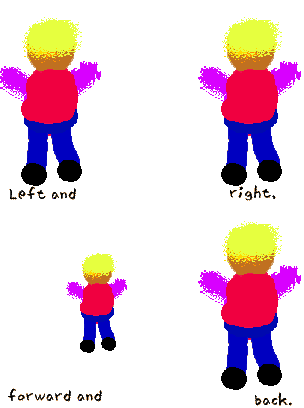
For other countries I’d recommend Left & Right as it’s very simple and kids everywhere enjoy it.
Ninja Tip: Watch out that you must face away from the kids, so they don’t mix up your left and right with their left and right. ( i.e. if you are facing them and you move right, it’s their left!).
The song usually thaws any ice that’s left and gets everyone happy and smiley.
In subsequent lessons just work your way through the curriculum, learning the local language for each of the themes as you go along.
Ninja Tip: Because the Genki English curriculum is written with language the kids want to ask, it’s also a really great base for your own language learning!
And, as you’ve probably realised, my main advice would be, obviously, to learn some of the students’ language.
Just a couple of words to start things off really breaks the ice and the tension.
Plus if you can listen to what the students are saying it makes planning the lesson a whole lot easier.
The rule is to use the kids’ language:
As little as possible, but as much as necessary.
In the beginning they need lots of help for both meaning and, most importantly, motivation. But as you teach something, you only ever use it, and accept it, in English. Eventually you’ll get to the 100% English classroom, but not in the beginning.
Just imagine if you had to teach Chinese to your friends back home, would you need any English?
Luckily there’s lots of material on the net to help you, especially on YouTube, and you might want to have a look at my materials for Korean, Japanese and German.
And of course there’s the whole trust issue of “Why should I trust a foreign language teacher who hasn’t taught themselves our foreign language?”. Would you go to a guitar teacher who couldn’t play the guitar?
🙂


Thanks for this! I’m teaching at an international school and we just had two new Russian students join our class. I don’t have an EAL programme here, or a TA to work with the kids, so I’ve been trying to integrate some more games and songs that everyone in the class will enjoy! The ‘robot game’ using the left and right/ stand up sit down instructions is a big hit here!
Dear sir,
I plan to set up a nonprofit organization which provide high quality to the poor children and found that your lessons are very very useful. It is very like. The npo will use many of your tips and advices. 🙂
Thank you very much.
I pray that God will bless you.
-Aimi
After teaching for ten years at an eikaiwa (English Conversation school), which was a completely English environment, and then changing to teaching English at a yochien (kindergarten), which has mainly been taught in Japanese, I was surprised by how much Japanese the teacher used. Simple instructions, like “sit down” and others like that are always in Japanese. In fact, the only English that was really used before I got there was for the sentences/words he would practice, like “When you grow up, what do you want to be?” and “When I grow up, I want to be a soccer player.” which were drilled daily for who knows how long.
I understand the need of using Japanese to explain the meanings, but what shocked me the most was that even though the kids could say these super long sentences, they couldn’t say “My name is…” or even “I’m ….” to introduce themselves, nor could they answer “How are you?” even though they’d been learning for nearly 2 years! Granted, the kids have had several teachers over the last two years with little to no continuity in their lessons, so it’s not surprising.
Now I’m team teaching with the other teacher (which is good because my Japanese is far from perfect) and I’ve got most of the kids saying “Good morning” every day and reviewing “How are you?” nearly every lesson, so they’re beginning to become more realistically fluent for their ages.
I do have one comment on your post, though. “Would you go to a guitar teacher who couldn’t play the guitar?” is not an analogy I would make for English teaching, because, obviously, you wouldn’t go to an English teacher who can’t speak English, but that doesn’t mean they are a bad teacher if they don’t speak another language. Perhaps it would be better to say, “Would you go to a guitar teacher who couldn’t read music?”
Thanks for your tips and pointers!
Tammy 🙂
Reading this is inspiring me to rearrange the prospective curriculum I am putting together, though I was feeling like getting into colors earlier has always been the way I’ve done things and seen things in books.
I realized this while I was teaching my students. There are some things that need to be explained in their L1 if the students cannot understand me however I explain things to them.
It’s also great to know their language because there are times when my students use their L1 suddenly, so to know what they’re saying is an advantage.