
 Level.
| Click the pictures, hear them talk! | ||||||||
|
Owners Club
|
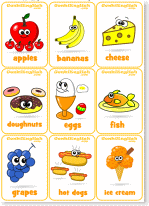
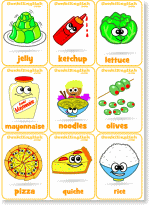
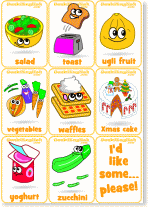
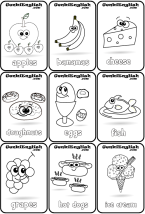
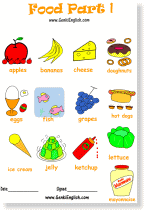
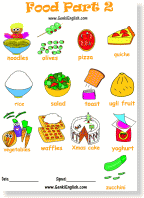
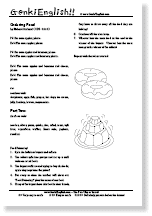
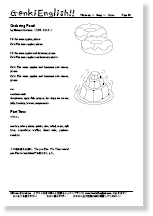
| "Food" by Richard Graham I'd like some apples, please. He'd like some apples, please I'd like some apples and bananas, please. He'd like some apples and bananas, please. He'd like some apples and bananas and cheese, please. He'd like some apples and bananas and cheese, please etc. continue with: doughnuts, eggs, fish, grapes, hot dogs, ice cream, jelly, ketchup, lettuce, mayonnaise. "Food Part II" by Richard Graham This is the same as above, but this time the list of foods is: noodles, olives, pizza, quiche, rice, salad, toast, ugli fruit, vegetables, waffles, Xmas cake, yoghurt, zucchini. |
. To make sure the song is not simply repeating, the song is written like
the kids are ordering for you at a restaurant, or on the phone.
You start off by saying "I'd like some apples, please".
And the kids say "He/She'd like some apples, please".
Then the fun begins, as the second time it's "I'd like some apples and bananas, please".
Then once the kids have said their line it's "I'd like some apples
and bananas and cheese, please".
And on, and on, and on till you'll end up with "I'd like some apples
and bananas and cheese and doughnuts and eggs and fish and grapes and hot
dogs and ice cream and lettuce and mayonnaise, please!". Crazy, but
fun!
It's just like the "12 Days of Christmas" in that each repeat helps you memorise the earlier words. It starts out slow, then speeds up ( most kids will find somewhere in the middle to be just fast enough for them), but then gets very fast at the end - a great challenge to work up to. Once you've finished it feels like you've run a marathon, but thanks to the melody, you'll be singing it round and round in your head all day!
Then the next week you can go through the next set from noodles - zucchini.
And if you're really adventurous there's even a version on the software that
goes right from a to z in one go!
The key with this theme is the specially chosen set of words.
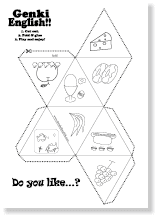
For starters all of them can be used just as they are with "I'd like some.." or "Do you like ....?" .
Teaching the words like this from the start means we avoid mistakes
such as "I like noodle" or "I like apple".
If you do
need the singular form of the word, it's simple, if it has an "s",
take it off, if it doesn't have one, use it as it is!! It's a lot easier
than learning the singular form and then having to worry about which ones
can and can't take an "s"!
You've also probably noticed that they go from a-z ( great for doing a
"food alphabet.")
And if you happen to be in Japan, then
with the possible exception of "quiche" and "ugli fruit"
( which were chosen for their starting letter!) they are all words that
Japanese kids will know the meaning of straight away.
This is great for 5th and 6th grade classes where you may have some kids
that say "I don't understand English!".
With these classes, you say you're going to do an activity where you'll
say an English word and they have to shout out what it is in their local language. And you just
read off this set of words and get them to translate. I've seen kids who've
been really adamant ( because of previous teachers or parents) that they
don't understand any English turn around and have the look that says "well,
yeah, I did understand those!". So this works great for giving a bit
of confidence! It's also cool for getting great pronunciation.
In this theme there are a couple of points that differ between American
and other Englishes. For example the "jelly" card I've used here
is the UK image of "jelly", as it also happens to be nearest
to the Japanese "zeli". If you're from the States you could always
use a picture of US "jelly". And then for the last word I've
chosen the American "zucchini". In the UK people would probably
use "courgette". These differences
are always useful for the kids to learn that not everyone says everything
in the same way!
Recommended Games:
"The Blob!"
Or "I like soooo many foods!
Picture Books
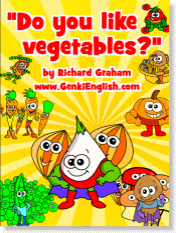
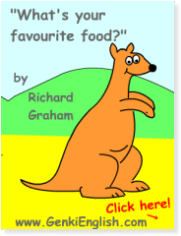
There are also the online "I love vegetables" and "What's your favourite food?" picture books for this theme.
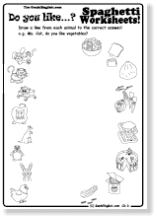
Worksheet:
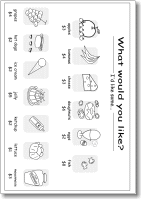
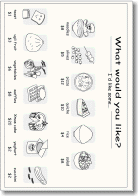
This is best in groups. The teacher says "I'd like some" + several
foods. The kids find out how much each food costs and shout out the total
price! Try again, gradually adding in more and more foods or get the kids
to try!
Enjoy your foods!
Readers' Comments
Sign up to get my top tips, games & hints via email! |
 |
|---|
|
|

HI Richard,
I love the new graphics and the software.
Hi again,
Love the new graphics
Thanks muchly for the update Looks great!
awesome! Thanks a lot, I love the way you can up grade
the themes like this! Thanks so much
Hello Richard,
I just worked through the whole stuff, first of all I think it's great.
I love the 3rd game, this will be great fun with my private groups at home.
Thanks a lot,
Carla Chazottes
All of the foods are so cute! I also like that the newer voices have a slower speech rate for the words menu and for the games. Everything worked well for me. Thank you for your hard work!
hello Richard. it,s great. I love it.
IT'S GREAT! THANKS RICHARD!