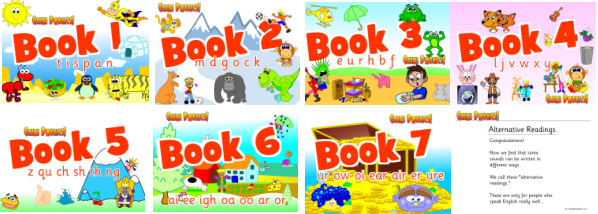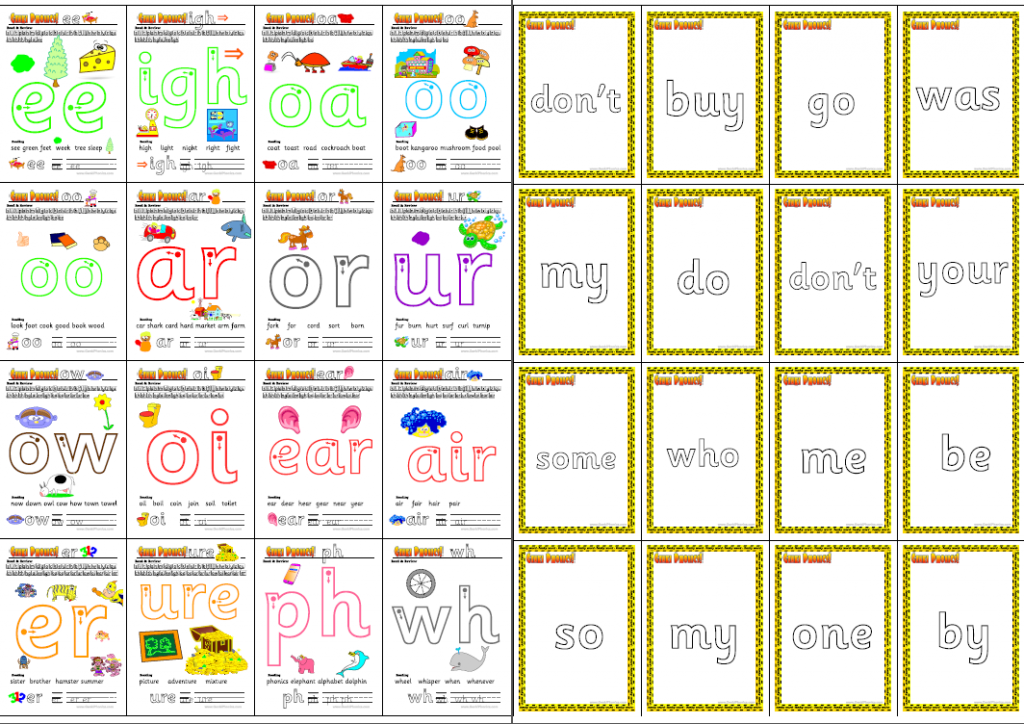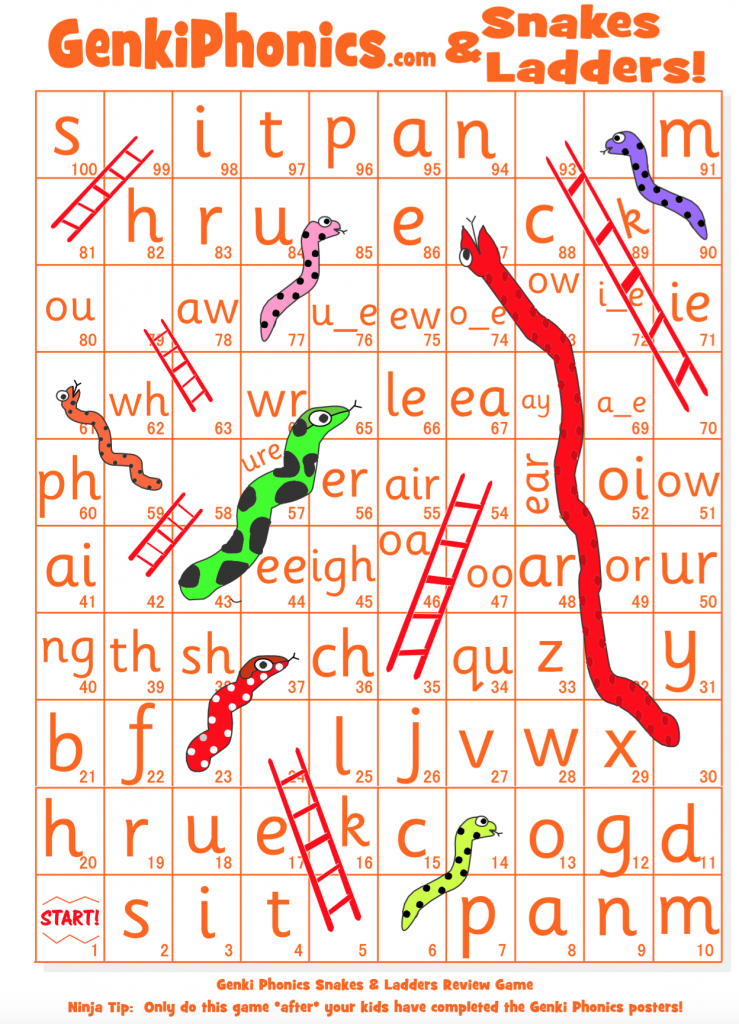

Free Printables:![]() A4 Posters ![]() "Islands" Game ![]() Snakes & Ladders more... Kids Phonics CD ![]() 10 Brand New genki songs, audio mini lessons and games for teaching phonics! Out now!! Or if you are Outside Japan. Also check out the normal Genki English CDs in the CD Set |
The idea of phonics is that you teach your students the various English
sounds, then the letters they correspond to. The advantage of this over
simply teaching the alphabet is that once they have mastered the main sounds,
they can then read many English words.
On this page kids will find enough material to cover all the basics. So
tell your students about the page so they can practise at home, it's a
great way to show parents how well you are teaching them in class!
The problem with traditional phonics is that if you have a printed
book, you can't hear the sounds, similarly if you have an audio cassette,
you cannot see the letters. So that's why I came up with this page, where
you can hear the sounds, see the letters and have full control over which
ones to study.
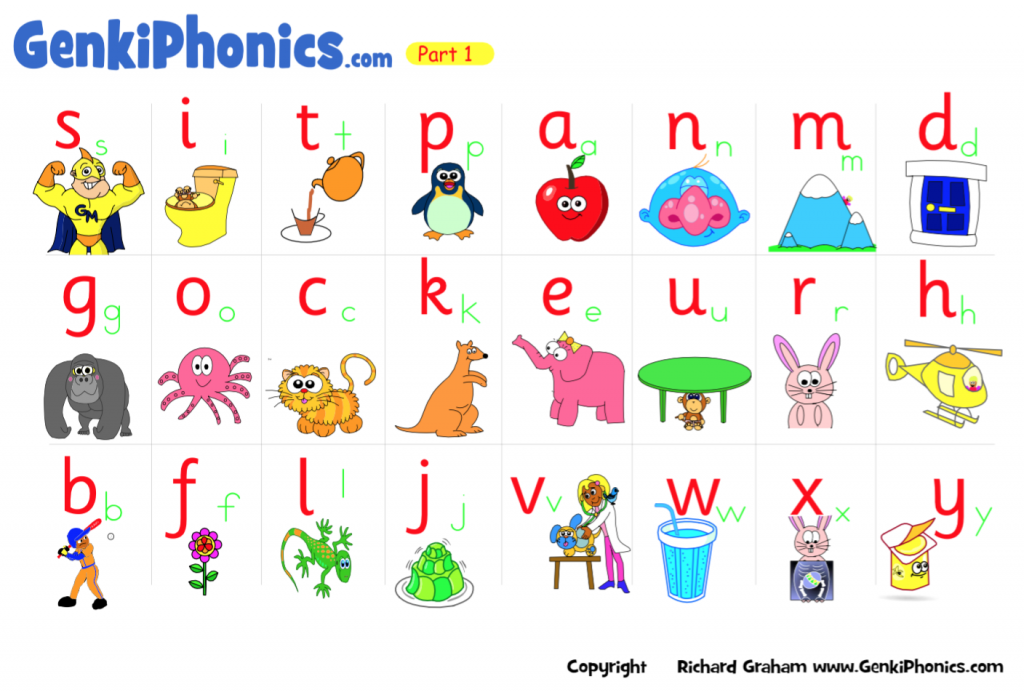
In the table above you have the 5 vowels, the 21 consonants and several
"blend" and "combination" sounds where consonants are
used together. Move your mouse over the sounds to hear them pronounced,
or click on the pictures to hear them.
Most areas of the World pronounce consonants in the same way, however regional
accents appear in the vowel sounds. New Yorkers have different vowels from
Texans, Londoners are different from Glaswegians. Here I've presented two
variations. When you teach, choose one, but make sure the kids know there
are many variations.
The games on here are great as the time limits really make sure the kids
start listening and not just looking at the letters (hence why kids will
always beat adults!). The pronunciation has no strange Japanese accents
and above all they are fiendishly addictive games!
@
At Home: First of all the parent and child should play around with the talking
phonics table at the top of this page. When that gets a little boring,
have a try at one of the games. Take it in turns to see who can get the
highest score! Then play around a little more, then try the next game.
Private English Classes: Most private English classroom tend not to have computers. So what I would
recommend is to do a normal Phonics Course during the lessons, and then
give this page as homework. The kids can play their games at their own
pace, record their best times and then compare them in the next lesson.
And remember the golden rule "Losing doesn't mean losing. It's just
another chance to try again!"
Elementary School: According to the Ministry of Education the main aim in Elementary School
should be for the kids to develop a love for English and be able to communicate
in it. Hence have a look at my curriculum page. But if you have the time then phonics can be a fantastic way to get the
kids used to English sounds. The best way to do this is to use the school's
computer room. Ideally it would be one kid per computer, but obviously
this depends on how many machines you have! First of all show the students
this page, and let them play around on the talking part at the top. Then
after a few minutes let then try the first game on their own. After a couple
of tries, have a class competition! This is where the games really work!
The teacher says "Go!" and the kids all press start at the same
time. Who's the quickest? It's a great motivation builder and as the tiles
come up randomly it gives kids who are maybe weaker at English just as
much chance to win! Once you've done that a couple of times, let the kids
play freely on the next game, and then do another class challenge. And
of course this page is great as homework. The kids can do some great English
practise at home and their parents can see the progress they are making.
That's the reason why instead of making these games into a CD, I put them
on the site for free, so that anyone can freely use them and get the basic
English sounds sorted! So tell everyone you know about the page and let's
get everyone genki about English!
Junior High School: Teaching the first year junior high students phonics makes a huge difference.
It is actually one of the methods recommended by the Ministry of Education
and the influence phonics has on the kids ability to read cannot be underestimated.
The best way to use the page is in the computer room just as I describe
above for elementary school. Of course for Junior High 2 or 3 it's a bit
late to be learning the sounds of English, but if you have a genki class
it can work really well! You probably also want to get yourself a copy
of the Foxy Phonics JHS book.
Adults: Kids will always be better than adults at these games, but if you are
studying English then this page can be really useful too! Just one thing
to watch out for is not to start saying the letters in your native language
(such as "bu", "da" etc. for Japanese speakers), but
to really try with the real English sounds. If you try really hard then
most of the English sounds are presented in these games, which means by
using this page you should be able to read almost any English!!
Let your students have a go and see how they get on!
If you have any comments or questions I'd like to hear them, please get in touch!
And if you have any friends who you think would like this page, please
tell them about www.GenkiEnglish.com !!
I got the inspiration for this from working
on a similar page for learning Japanese "hiragana"
and "katakana" - you can have a
look on the Genki Japan Page!
Or if you teach math, have a look my fun math games!
New Genki Phonics Songs!!
If you like this page you'll probably be interested in my new "Genki
Phonics CD".
On this audio CD there are 10 songs for the sounds b, c ( or k), d, f,
g, h, j ( or the soft "g"), l, m & n. The melodies are infectious,
the production is up-to-date and best of all the lyrics for each song are
just that sound i.e. for the "b" song it's "b,b,b,b b,b,b,b
" - so your kids will always remember the lyrics!
To get the most out of the songs the kids have to first practise the sound
and then learn how to sing the song. To help with this each track has its
own audio "mini-lesson" where I teach the song, of course in
a very Genki way. The mini-lessons are all in English, but the kids can
follow no problem, and these mini-lessons mean it's much easier for you
to teach!
Then as an extra bonus there is a simple "odd-one-out" audio quiz for each track to see if they really do know the sounds ( check out the free worksheets below to go with these games) !
So there you go, the genkiest way to learn phonics! Perfect as a stand
alone 5 minute section of a regular class, or to genkify a more traditional
phonics course.
The Genki Phonics CD is available now priced 2,940 Yen ( including tax)
+ Post and Packing
![]()
Or click here for the Fax order form. ( It's in Japanese so you can show it to your school and hopefully get them to pay!)
If you live outside Japan you can now order the Genki Phonics CD by credit card
(Note: The Phonics CD is not included in the "6 CD Set" or "Superpack". Unlike the other Genki English CDs, the Phonics CD only contains
audio tracks)
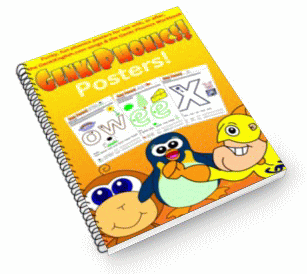
. Not only is there this talking Phonics pageon the site, I've now produced some phonics worksheets for you to use in
class.
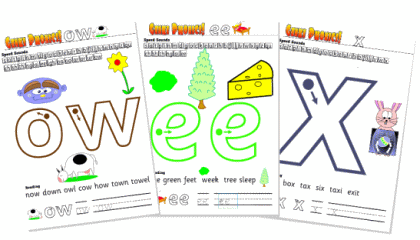
The idea with these sheets is that they can be used to teach kids phonic awareness, the relationship between written characters and their associated sounds, in a very easy and fun way! These sheets are copyrighted, however you may download them and use them in your own class.
example of 'b'
Great to put up on the board, each sheet features one lower case letter.
Use them with the songs on the new Genki Phonics CD.
Click on each letter to bring up the A4 print out.
a - b - c - d - e - f - g - h - i - j - k - l - m
n - o - p - q - r - s - t - u - v - w - x - y -z

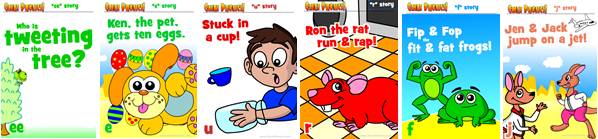
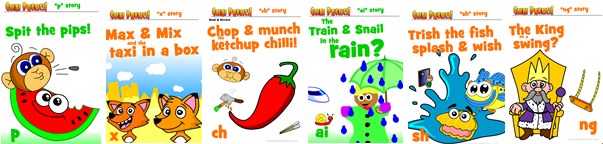
Phonics worksheets to be used with the games on the new Genki Phonics CD!
Great to print out and give to students.
Click on each letter to bring up the A4 print out.
b - c - d - f - g - h - j - l - m - n
All feedback is much appreciated!!
Normal phonics worksheets are here.
By introducing one letter/sound per lesson, you can still spend most of the time doing songs and games, i.e. the important "communication English". But over time you'll build up a great foundation which should help the kids speak with better accents and give them a huge head start when they learn to read. When the kids have computer lessons, try out the Talking Phonics Games or even better, get them to do the games as homework! If you're teaching in an English school, you probably have a good idea of how to introduce phonics, so use these ideas to spice up your lessons and motivate the kids! |
The Genki Phonics CD is available now priced 2,940 Yen ( including tax)
+ Post and Packing
![]()
If you live outside Japan you can now order the Genki Phonics CD by credit card!
|
If you like this page, please tell a friend. |
|
|